Improving Cross-Domain Robustness of Speech-Based Alzheimer’s Disease Detection with Unsupervised Domain Adaptation
Abstract
As Alzheimer’s disease (AD) has increasingly become a major global public health issue, speech-based AD detection has attracted widespread attention. However, most existing methods are trained and evaluated on a single dataset, often leading to severe cross-domain performance degradation due to reliance on dataset-specific artifacts rather than disease-related speech cues. In real-world applications, reliable Alzheimer’s disease detection requires models that are robust to variations in recording environments, speakers and data collection conditions. To address this challenge, this paper adopts unsupervised domain adaptation to learn robust, domain-invariant feature representations in the absence of target-domain diagnosis labels. On this basis, a novel unsupervised domain adaptation method, Iterative Adversarial Self-Training (IAST), is proposed. Experimental results demonstrate that IAST significantly improves the generalization ability and robustness of the models under various cross-domain settings.
Key Contributions
- We design three AD detection models with increasing representational capacity, spanning handcrafted acoustic features, pre-trained self-supervised speech embeddings, and task-specific fine-tuning.
- We conduct a systematic cross-domain evaluation of AD detection across multiple models and unsupervised domain adaptation strategies.
- We propose a novel unsupervised domain adaptation method, Iterative Adversarial Self-Training (IAST), which significantly improves cross-domain generalization and robustness.
Model Architecture
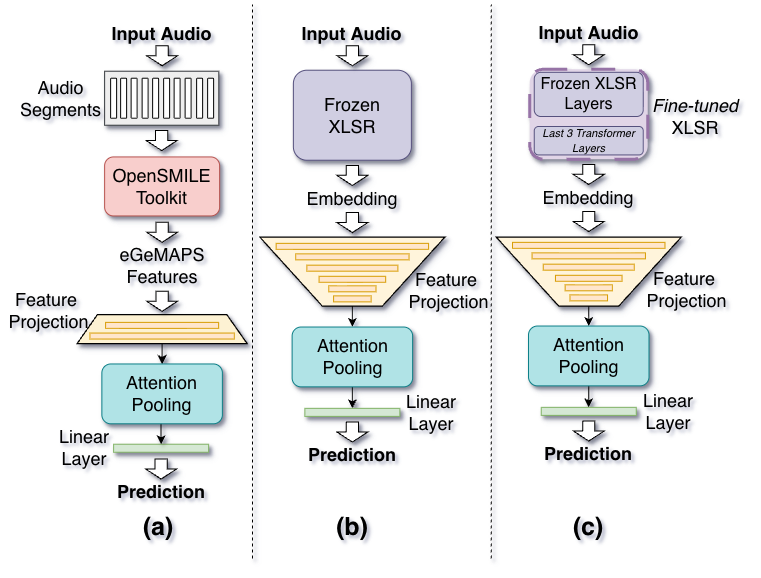
We implement three speech-based Alzheimer’s disease detection models with increasing representational capacity: an eGeMAPS-based model using handcrafted acoustic features (Figure a), a pre-trained embedding-based model with frozen parameters (Figure b), and a fine-tuned pre-trained model for the target task (Figure c).
Download Code
Iterative Adversarial Self-Training (IAST)
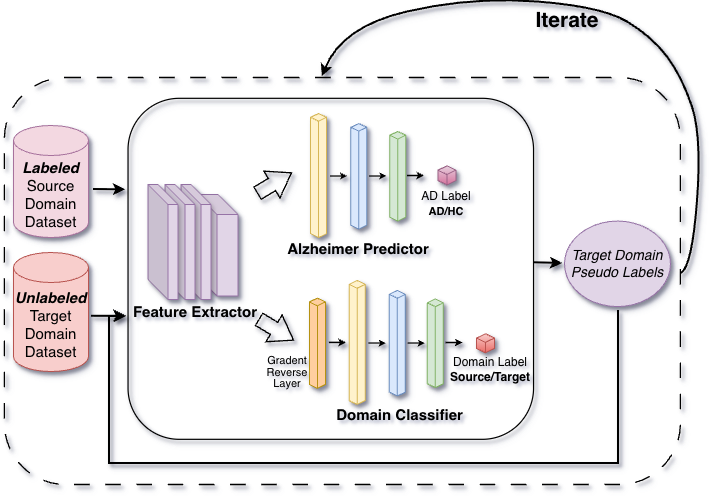
Iterative Adversarial Self-Training (IAST) is the unsupervised domain adaptation method proposed in this paper, which combines the advantages of DAT and ST in cross-domain learning. The key idea of IAST is to progressively improve target-domain pseudo-label quality through repeated feature alignment and target-domain adaptation. The proposed pipeline of Iterative Adversarial Self-Training is illustrated in Figure.
Experience and Results
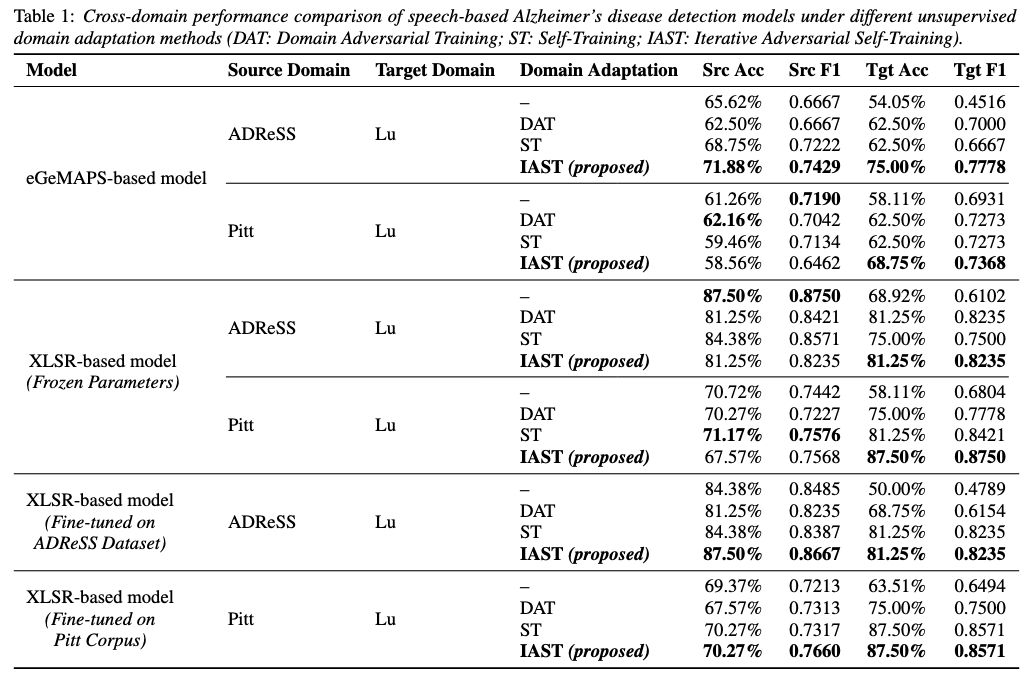
As shown in Table, IAST consistently yields the strongest target-domain performance across different model architectures and source–target settings, outperforming or matching the best results achieved by traditional unsupervised domain adaptation methods.